









How to Verify If a Custom LED Factory Has True Mass-Production Capability
November 10, 2026
specializes in SMT LED beads and LED piranha beads.
For procurement and engineering teams sourcing customized LEDs, the single biggest risk is not whether a supplier can make a good sample — it is whether they can replicate that sample quality consistently across tens of thousands of units, batch after batch.
Every custom led manufacturer can deliver a handful of hand-tuned prototypes; far fewer can translate custom specifications into stable, repeatable mass production with controlled variation, reliable yield and on-time delivery.
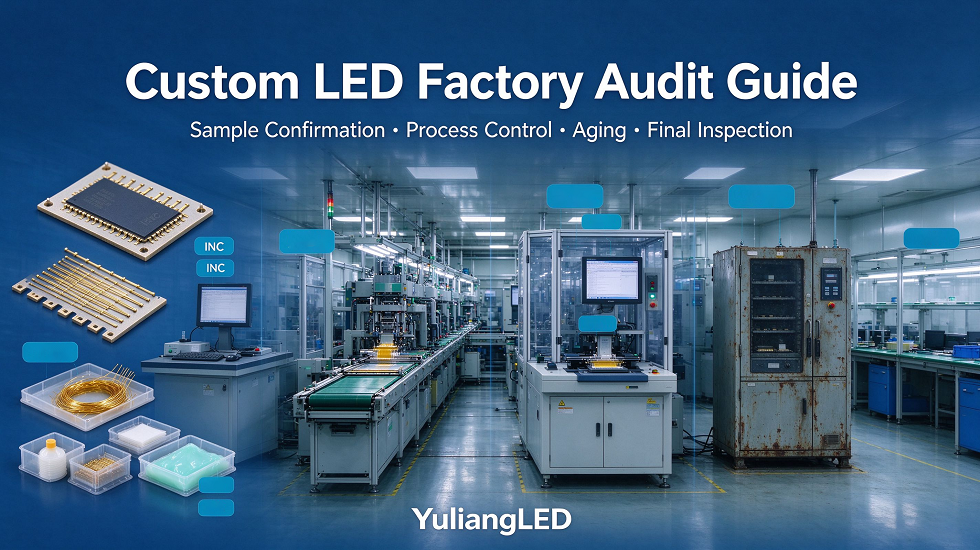
Evaluating a led custom factory for volume capability requires more than reviewing a datasheet and approving a sample set. It demands a structured audit across the entire production workflow — from sample confirmation and incoming material inspection through in-process control, aging testing and final verification.
Why Custom LED Mass Production Is Harder to Validate Than Standard Products
Standard catalog LEDs are produced on mature, long-running lines with proven, stable processes.
Custom LED programs are different by definition: special binning, custom wavelengths, unique packaging, integrated optics, modified electrical parameters or application-specific formulations all introduce variables that do not exist in standard production.
For buyers, the cost of getting this wrong is high: batch-to-batch parameter drift, elevated defect rates, delayed deliveries and costly rework at your own production line.
The only reliable way to avoid these outcomes is to audit the full production process, not just evaluate finished samples.
Six-Stage Factory Audit Framework for Custom LED Capability
Stage 1: Sample Confirmation — From Handcrafted Prototype to Production-Ready Specification
Sample approval is the starting line, not the finish line. What matters most is not whether the sample performs well, but how it was made and whether the specification can be replicated on a production line.
Stage 2: Incoming Quality Control (IQC) — Custom Materials Deserve Custom Inspection Standards
Custom LED performance starts with the raw materials. If chips, substrates, wires and encapsulants do not meet your custom requirements, no amount of production tuning will fix the result.
Stage 3: In-Process Quality Control (IPQC) — Where Batch Consistency Is Actually Built
This is the most important and most commonly overlooked stage. Samples can be polished, final inspection can sort out defects, but only strong in-process control produces consistent quality across an entire production run.
Stage 4: In-Process Verification — Catching Deviations Before They Become Batch Failures
Beyond routine IPQC, strong custom led supply operations perform structured verification at key transition points to catch drift early.
Stage 5: Aging / Burn-In Testing — The Ultimate Reliability Screen for Custom Parts
Custom LED programs often push parameters closer to performance limits than standard products, making early-life failure screening even more important. Aging testing under powered load filters out infant-mortality defects before units reach the customer.
PREVIOUS ARTICLE