









Cómo verificar si una fábrica LED personalizada tiene una verdadera capacidad de producción en masa
November 10, 2026
se especializa en perlas led SMT y perlas piranha led
Para los equipos de adquisiciones e ingeniería que obtienen LEDs personalizados, el mayor riesgo no es si un proveedor puede hacer una buena muestra, sino si pueden replicar esa calidad de muestra de manera consistente a través de decenas de miles de unidades, lote tras lote.
Cada fabricante led personalizado puede entregar un puñado de prototipos sintonizados a mano; mucho menos pueden traducir especificaciones personalizadas en una producción en masa estable y repetible con variación controlada, rendimiento fiable y entrega puntual.
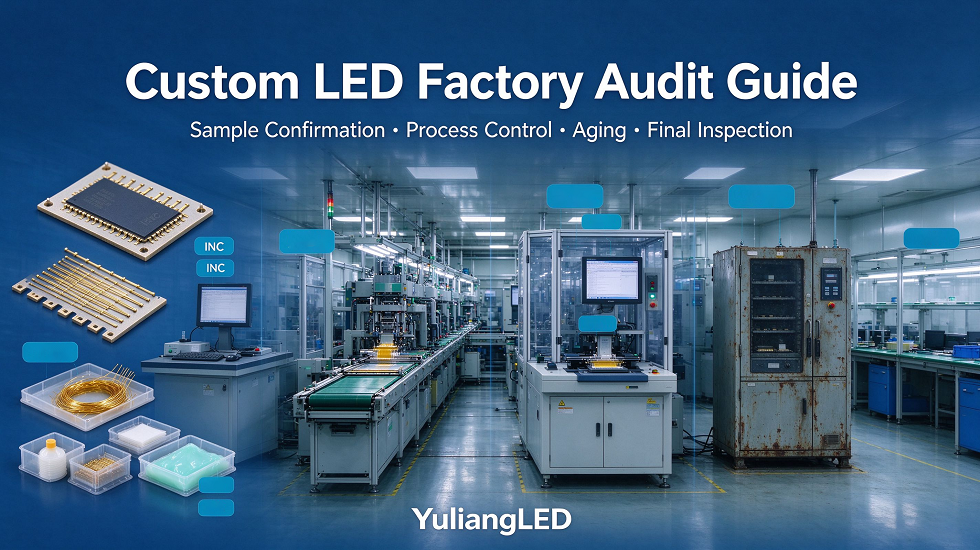
La evaluación de una fábrica led personalizada para la capacidad de volumen requiere más que revisar una hoja de datos y aprobar un conjunto de muestras. Requiere una auditoría estructurada en todo el flujo de trabajo de producción, desde la confirmación de la muestra y la inspección del material entrante hasta el control en el proceso, las pruebas de envejecimiento y la verificación final.
Por qué la producción en masa LED personalizada es más difícil de validar que los productos estándar
Standard catalog LEDs are produced on mature, long-running lines with proven, stable processes.
Custom LED programs are different by definition: special binning, custom wavelengths, unique packaging, integrated optics, modified electrical parameters or application-specific formulations all introduce variables that do not exist in standard production.
For buyers, the cost of getting this wrong is high: batch-to-batch parameter drift, elevated defect rates, delayed deliveries and costly rework at your own production line.
The only reliable way to avoid these outcomes is to audit the full production process, not just evaluate finished samples.
Six-Stage Factory Audit Framework for Custom LED Capability
Stage 1: Sample Confirmation — From Handcrafted Prototype to Production-Ready Specification
Sample approval is the starting line, not the finish line. What matters most is not whether the sample performs well, but how it was made and whether the specification can be replicated on a production line.
Stage 2: Incoming Quality Control (IQC) — Custom Materials Deserve Custom Inspection Standards
Custom LED performance starts with the raw materials. If chips, substrates, wires and encapsulants do not meet your custom requirements, no amount of production tuning will fix the result.
Stage 3: In-Process Quality Control (IPQC) — Where Batch Consistency Is Actually Built
This is the most important and most commonly overlooked stage. Samples can be polished, final inspection can sort out defects, but only strong in-process control produces consistent quality across an entire production run.
Stage 4: In-Process Verification — Catching Deviations Before They Become Batch Failures
Beyond routine IPQC, strong custom led supply operations perform structured verification at key transition points to catch drift early.
Stage 5: Aging / Burn-In Testing — The Ultimate Reliability Screen for Custom Parts
Custom LED programs often push parameters closer to performance limits than standard products, making early-life failure screening even more important. Aging testing under powered load filters out infant-mortality defects before units reach the customer.
Stage 6: Final Quality Control (FQC / OQC) — Final Verification Before Shipment
ARTÍCULO ANTERIOR