









How to Choose the Right LED Profile Supplier
November 5, 2026
For lighting manufacturers, architectural contractors and commercial project buyers, LED profiles are easy to underestimate. They appear to be simple aluminum channels — but their dimensional accuracy, thermal performance, surface finish and accessory compatibility directly determine installation efficiency, LED service life and the visual quality of the final installation.
Selecting the wrong led profile supplier leads to misaligned parts, poor heat dissipation, visible hot spots, batch-to-batch color mismatch and costly on-site rework.
The challenge for B2B procurement is not finding a company that sells aluminum profiles — it is identifying a led profile manufacturer that can consistently deliver precise, reliable products from prototype through to volume production, with the flexibility to support both standard and custom project requirements.
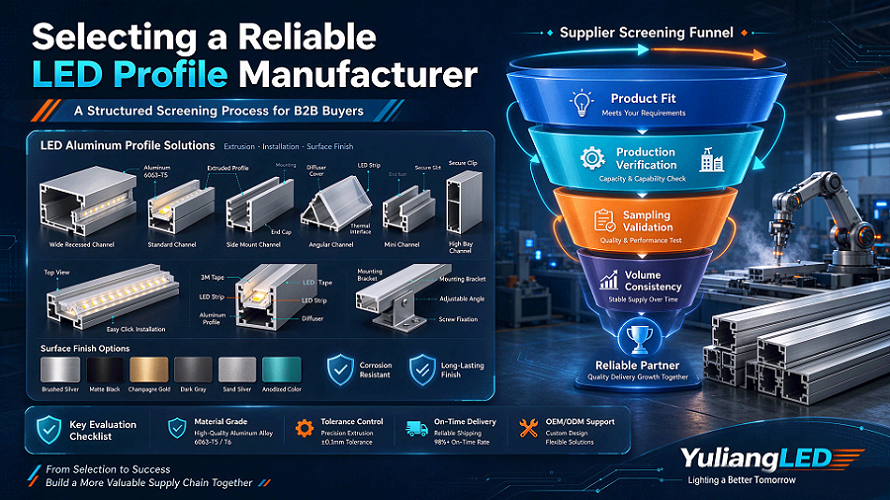
This guide establishes a structured screening framework covering product range, customization, production capability, MOQ, lead time, quality control, OEM/ODM support, technical service and batch consistency, so you can qualify suppliers systematically rather than deciding on price alone.
1. Product Range & Specification Completeness
A capable supplier should offer a broad enough portfolio to cover your current and future project needs, without being so broad that they lack specialization. Before evaluating anything else, confirm that the supplier carries profiles that physically match your LED strips and installation method.
2. Customization Capability
Standard profiles work for simple projects, but most commercial and architectural applications require some degree of customization — whether it is a special dimension, custom surface finish or unique cross-section. A led profile manufacturer with strong customization capability can adapt to your design, rather than forcing you to adapt to their catalog.
A supplier that owns its own tooling shop and extrusion lines can iterate quickly on custom designs. Suppliers that outsource tooling and production will have longer lead times, higher costs and less control over quality.
3. In-House Production Capacity
Many companies market themselves as manufacturers when they are actually trading companies sourcing from third-party factories. For B2B buyers, this means no control over lead times, no direct technical support and no accountability for quality issues. Verifying genuine production capability is the most important step in supplier qualification.
4. MOQ Flexibility
Minimum order quantity requirements vary dramatically between suppliers and between standard versus custom products. A supplier with rigid MOQs can force you to carry excess inventory or reject small-batch project opportunities.
5. Lead Time Reliability
On construction and rollout projects, delayed profile deliveries hold up electrical installation, finishing work and final occupancy. A supplier that quotes fast lead times but consistently misses deadlines creates far more cost than a slightly higher unit price.
PREVIOUS ARTICLE