









How to Build a Stable Supply Chain for LED Electronic Products
November 9, 2026
For OEMs building LED-driven electronics — from smart lighting systems and industrial control panels to medical devices, automotive interior modules and consumer appliances — supply chain stability is the invisible backbone of product profitability.
A single shortage of LEDs, drivers or passive components can halt an entire production line, delay product launches and erode customer trust.
Yet many procurement teams still treat led electronics supply as a straightforward purchasing task, underestimating how quickly upstream disruptions can cascade into downstream crises.
In today’s market, volatility is the new normal: wafer capacity tightness, raw material price swings, geopolitical trade shifts and product obsolescence all put continuous supply at risk.
Understanding the LED Electronics Supply Chain: Where Risks Originate
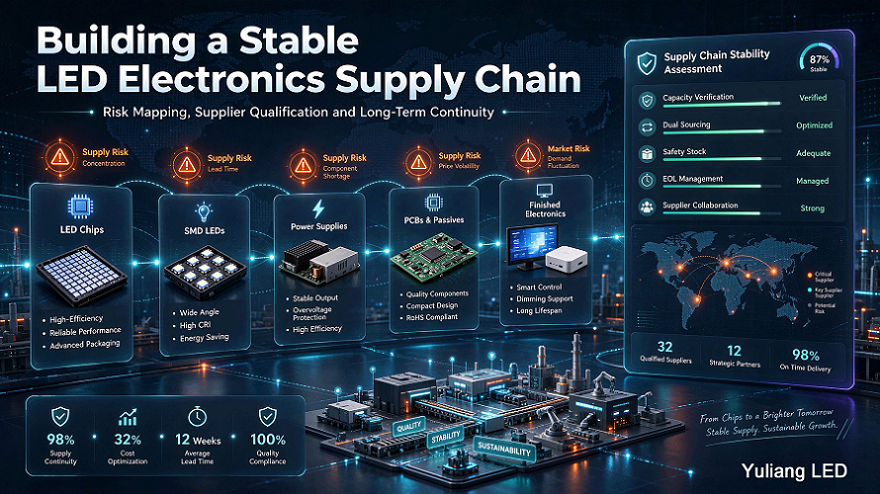
A finished LED electronic product depends on multiple upstream layers, and disruption at any single layer can stop production. Effective risk management starts with mapping each link and its typical failure points.
1. LED components: The optical core
LED chips, packaged SMD LEDs and high-power emitters are the heart of the product. This layer is controlled by a relatively concentrated group of chip foundries and packaging houses.
2. LED power supplies and drivers: The electrical backbone
Every LED product requires a driver or power supply to regulate current and voltage. The led power supply manufacturer contributes not only hardware but also compliance and reliability characteristics.
3. Core electronic components: The supporting ecosystem
PCBs, capacitors, resistors, connectors, microcontrollers and sensors complete the system. Many of these follow broader semiconductor and passive component market cycles.
4. Mechanical and assembly layers
Housings, lenses, optics, thermal materials and contract assembly services form the final layer.
The Three Highest-Risk Links for Supply Disruption
Not all supply chain risks are equally likely. Based on industry patterns, three categories consistently cause the most production disruptions for LED electronics programs.
1. Upstream chip and wafer level constraints
LED chip production depends on epitaxial wafer capacity, which is capital-intensive and slow to adjust. When overall semiconductor demand is strong, wafer fabs prioritize higher-margin logic and memory chips over mature LED processes, creating allocation scenarios for LED die. This is not a hypothetical risk — the industry has been through multiple allocation cycles over the past decade.
2. Customized and semi-custom components
PREVIOUS ARTICLE