









Why You Should Never Choose LED Suppliers by Price Alone
November 11, 2026
For procurement teams in the led manufacturing business, cost reduction pressure is constant.
When evaluating led supply quotations, it is extremely tempting to simply select the lowest bid and check the box for savings.
However, the lowest unit price on a proforma invoice almost never equals the lowest total procurement cost.
Most expenses associated with LED sourcing never appear on the initial quote — they accumulate across production, quality control, inventory management, after-sales service and supply chain disruption, silently eroding product margins and operational efficiency.
Smart procurement for supply led programs does not chase the lowest sticker price. It evaluates total cost of ownership (TCO), measuring supplier value across delivery reliability, batch consistency, manufacturing capability and long-term partnership stability.
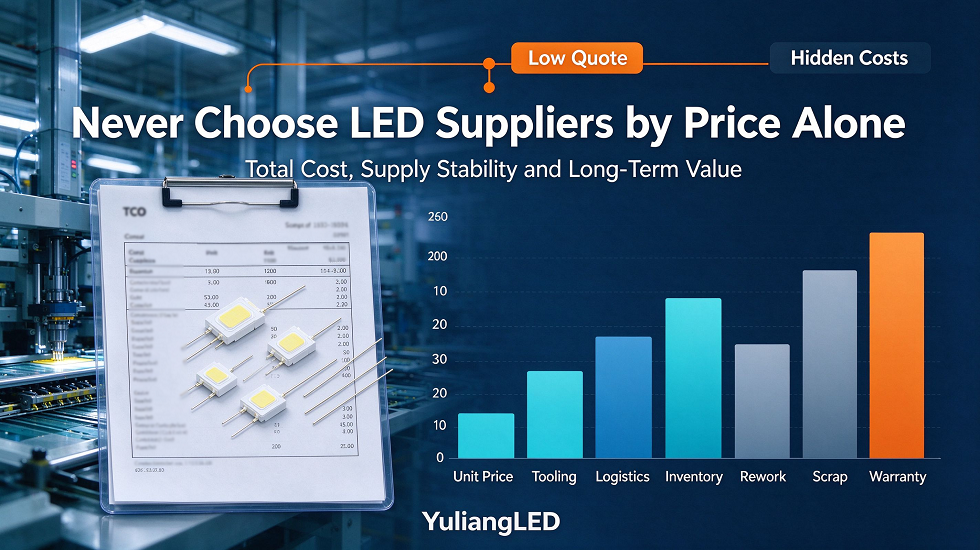
The Lowest Quote ≠ The Lowest Total Procurement Cost
The unit price of an SMD LED is the most visible cost metric, but it represents only a small fraction of true total cost. Industry research consistently shows that upfront component purchase price typically accounts for less than 20% of total lifecycle cost for electronic and lighting products. The remaining 80% consists of expenses that low-price suppliers almost always push onto the buyer.
For led manufacturing business operators, the correct question is never “who is cheapest?” — it is “who delivers the lowest total cost over the full production lifecycle of this product?”
Seven Hidden Costs Behind Low-Priced LED Supply
Every cost category below is routinely underestimated or completely ignored when procurement decisions are made on price alone.
1. Tooling and customization costs
Low initial quotations often exclude tooling charges for custom requirements. Special binning, custom wavelengths, integrated lenses, modified packages and unique form factors all require dedicated tooling and process tuning. Budget suppliers frequently charge separately for tooling, first-article setup and specification adjustments, and the cumulative cost of revision after revision can exceed the original component price.
Worse, low-precision tooling produces dimensional or optical deviations that cause downstream assembly problems, forcing additional redesign and rework expenses on your engineering team.
2. Shipping, logistics and in-transit damage losses
Budget led supply quotes are almost always priced EXW factory, excluding freight, insurance, customs duties and clearance fees. What looks like a great price can increase significantly once all logistics costs are added.
More importantly, low-cost suppliers often cut corners on packaging. Inadequate ESD protection, weak cushioning and non-standard packing lead to in-transit damage, bent pins, scratched lenses and moisture-related defects. The cost of returning defective batches, paying for replacement shipping and absorbing schedule delays far exceeds any per-unit savings. When production schedules are tight, emergency air freight to make up for lost time can cost more than the entire order itself.
3. Inventory and carrying costs
PREVIOUS ARTICLE