









How to Select Power Supply Solutions for Different Color LEDs
November 4, 2026
For engineering and procurement teams working on RGB lighting, dynamic signage, indicator systems and color-tunable fixtures, a common and costly assumption is that red, green and blue LEDs can all be driven by the same power supply with the same current settings.
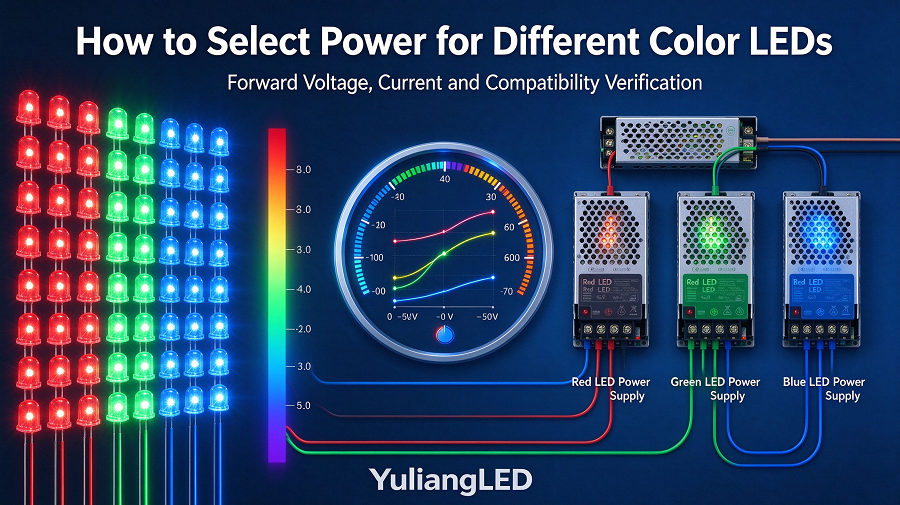
In practice, different color LEDs are built from different semiconductor materials, which means their forward voltage, current requirements and thermal behavior vary significantly.
Mismatched power solutions produce uneven brightness, inaccurate color mixing, accelerated degradation and even premature component failure.
Whether you are specifying a red led power supply for indicator and safety lighting, a blue led power supply for medical and special-application systems, or a multi-channel solution for full-color RGB projects, proper matching starts from the LED’s intrinsic electrical characteristics, not from the power supply catalog.
Why Color Determines Electrical Characteristics
The forward voltage (Vf) of an LED — the minimum voltage required to drive current through the junction and produce light — is not an arbitrary design choice. It is determined by the bandgap energy of the semiconductor material used to manufacture.
This fundamental material difference means a red LED and a blue LED of the same package size and power rating will have very different Vf values. For procurement teams, the implication is clear: a power solution optimized for one color will not necessarily work correctly for another, even if the package and nominal power appear identical.
Common Power Supply Architectures and Their Suitability by Color
Not all driver topologies are equally appropriate for every color. The right architecture depends on whether you are driving a single color or a multi-color RGB system, and what level of performance consistency you require.
1. Constant voltage with current-limiting resistors
This is the simplest and lowest-cost approach, commonly used for low-power indicator LEDs and basic strip lighting. A fixed voltage supply feeds each LED or string through a series resistor that sets the current.
2. Single-channel constant current driver
A constant current led supply regulates the output current to a fixed value regardless of variations in Vf, input voltage and temperature. This is the standard approach for high-performance single-color illumination systems.
3. Multi-channel independent constant current driver
For RGB and dynamic color systems, three independent constant current channels — one for each color — are required for accurate color mixing. Each channel is set to the correct current for its respective LED color, ensuring balanced brightness at every color setting.
This is the only architecture that delivers true consistent color rendering. Attempting to drive RGB LEDs from a single shared voltage supply will always produce incorrect white balance and uneven color transitions because red, green and blue channels will draw different currents at the same voltage.
How to Verify LED and Power Supply Compatibility Before Procurement
Use this structured verification process to avoid compatibility issues and ensure reliable performance from the first prototype through to volume production.
Step 1: Extract full Vf range from the LED datasheet
Step 2: Calculate total string voltage with margin
PREVIOUS ARTICLE