









Inside the Chip: Quality Control Standards of Top-Tier LED Manufacturing Business
November 12, 2026
For lighting brands, electronics OEMs and commercial project buyers, LED component quality is not a technical detail — it is a direct determinant of warranty cost, field failure rate and brand reputation.
A single low-quality batch of LEDs can trigger thousands of field replacements, erode customer trust and cost far more than the entire component purchase price.
Yet many buyers still evaluate a led manufacturer based on specifications printed on a datasheet, without understanding how those specifications are enforced on the production floor.
The truth is that not every manufacturer of led products builds quality into every process step.
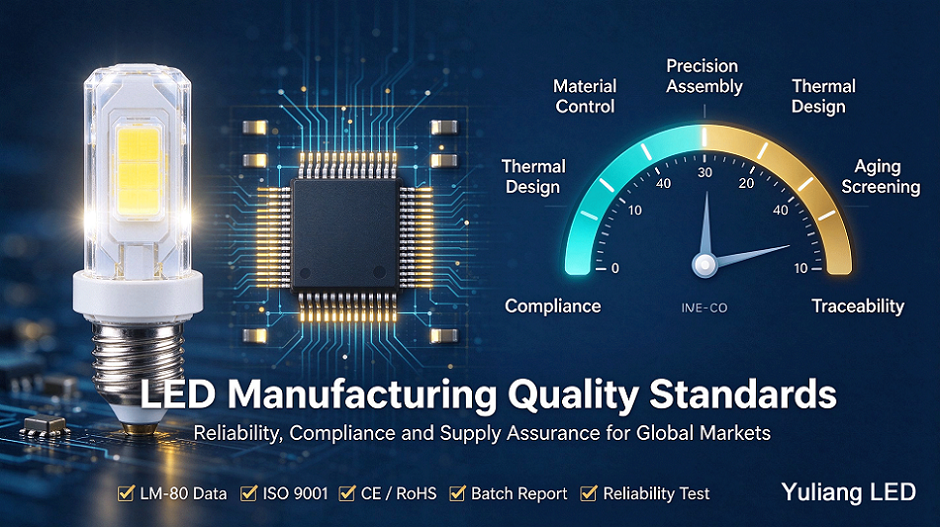
Top-tier led manufacturer operations do not achieve low failure rates by chance — they achieve them through systematic, multi-stage quality control that starts before raw materials enter the factory and continues long after finished units come off the line.
Why Field Failure Rate Is the Real Measure of LED Quality
Most LED suppliers publish similar nominal specifications on their datasheets: similar brightness, similar forward voltage, similar rated lifespan. In real-world operation, however, failure rates between suppliers can differ by a factor of 5 to 10.
For any business selling into international markets, the cost of quality failures is always higher than the cost of getting quality right from the start. This is why leading buyers do not just compare datasheet numbers — they audit the quality control systems behind them.
Stage 1: Chip and Packaging Quality Control
The foundation of LED reliability is laid at the chip and packaging stage. Defects introduced here are invisible at final inspection but will emerge as early failures in the field.
Incoming chip verification and binning control
Reputable led manufacturer operations do not take chip suppliers’ specifications at face value. Every incoming wafer lot undergoes full incoming quality verification:
-
Wavelength and brightness binning verification: Chips are retested to confirm they fall within the specified bin ranges. Tight binning control is what ensures consistent color and brightness across large installations.
-
Electrical parameter screening: Forward voltage, reverse leakage current and ESD withstand voltage are all verified against acceptance standards.
-
Appearance and defect inspection: Chip surface defects, cracking and contamination are screened out before packaging begins.
Encapsulation and phosphor consistency
The encapsulant and phosphor layer determine long-term optical stability. Poor encapsulation causes yellowing, color shift and lumen depreciation over time.
PREVIOUS ARTICLE