









LED Power Supply Procurement: How to Match Constant Current Drivers and Power Supplies Correctly
November 3, 2026
For engineering and procurement teams building commercial lighting fixtures, electronic devices or dynamic illumination systems, mismatched LED power solutions are one of the most common causes of field failures, product recalls and costly redesign work.
A constant current led supply selected without full consideration of LED forward voltage characteristics, load configuration and operating conditions can produce flickering, premature lumen depreciation or even catastrophic LED damage.
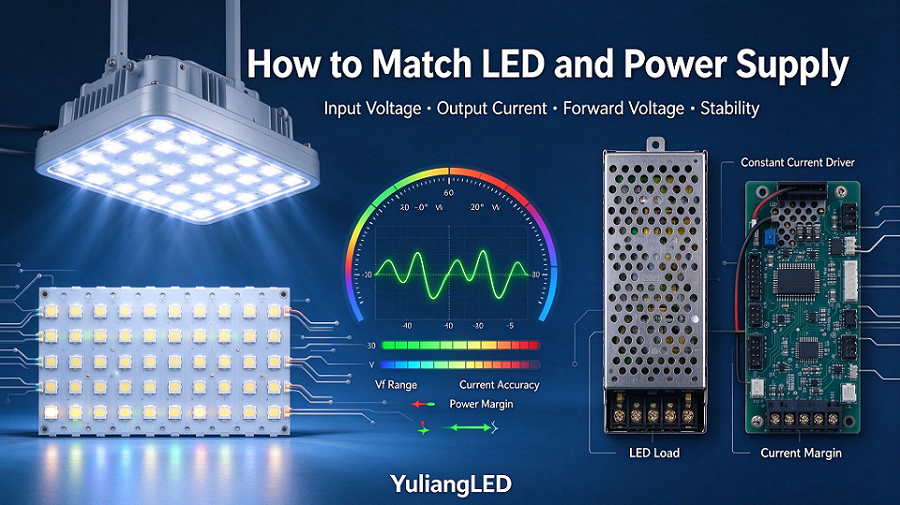
Proper matching requires a systematic review of input voltage, output current, forward voltage range, total power and long-term operating stability — and the selection process must start from the LED specifications, not from the power supply catalog.
First: Clarify Your System Type — Constant Current, Constant Voltage
Before comparing specifications, confirm which power architecture your application requires. The two most common procurement scenarios each follow different matching rules.
Constant current LED supply: The standard for high-performance illumination
Nearly all high-power and precision lighting applications use a constant current led supply architecture. LEDs are current-driven devices: their brightness is directly proportional to the forward current flowing through them, and their forward voltage varies with temperature, manufacturing tolerance and age. A constant current driver regulates the current to a fixed value regardless of these variations, ensuring consistent brightness and protecting the LEDs from overcurrent damage.
This is the default architecture for power led supply systems used in commercial downlights, street lighting, high-bay fixtures and medical beauty devices, where reliability and consistent optical performance are critical.
Constant voltage power supply: For modular and strip-based systems
Constant voltage (CV) supplies deliver a fixed DC output voltage, typically 12V or 24V. They are used for LED strips, signage modules and low-power indicator systems where each LED segment includes its own current-limiting resistor or simple driver circuit. While simpler to specify, CV systems are less efficient and less precise for high-power applications.
Five Core Parameters for Constant Current LED Supply Matching
When working with a constant current led supply, these five parameters determine whether the combination will work reliably over the product lifecycle. Skipping any one of them creates risk of early failure.
1. Input voltage range
The power supply must accept the AC line voltage present at the installation site. For global products, a wide input range ensures compatibility across different markets.
2. Rated output current
This is the single most important parameter for constant current systems. The driver output current must match the LED’s rated forward current exactly.
PREVIOUS ARTICLE