









How to Choose the Right Supply Solution for Smart LED Projects
October 22, 2026
For manufacturers of smart lighting and electronic products, LED procurement is no longer simply a matter of selecting color, brightness and package size. As dimming, RGB control, dynamic effects, intelligent control systems and connected product features become standard, LEDs must be carefully matched with drivers, circuits, controllers and complete system design.
Many procurement teams encounter the same pain points: samples perform perfectly in the lab, but mass-produced units show inconsistent brightness or color shift; LEDs work fine standalone, but flicker or fail when integrated with the control system; a supplier delivers well on the first order, but cannot maintain quality or lead times as volume scales.
The core truth is this: when selecting a supply solution for smart LED projects, B2B buyers must evaluate product performance, control compatibility, development support and mass production capability together — not just unit price and basic specs.
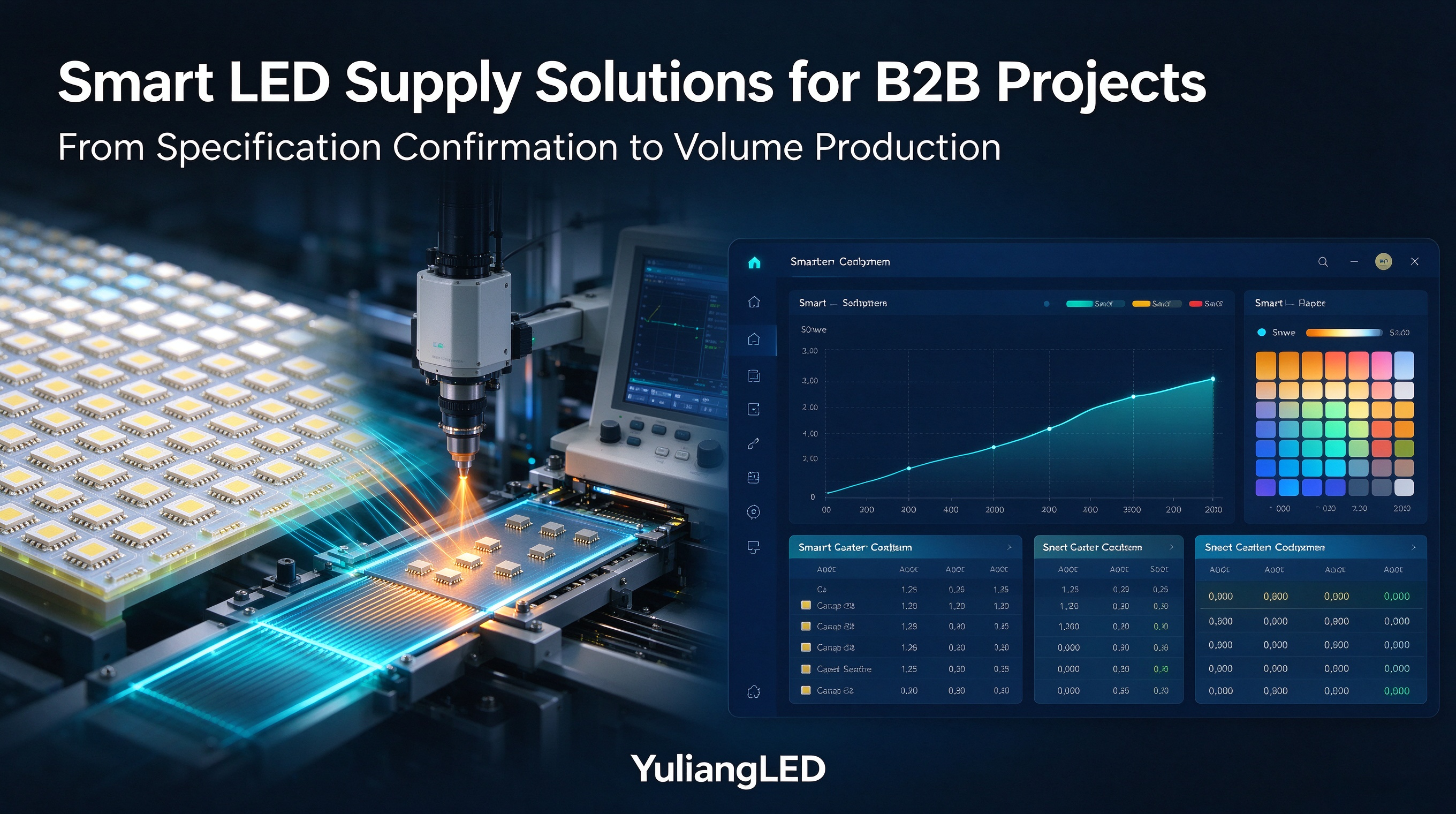
First: Define Which Type of LED Requirement Your Project Falls Into
Not all intelligent lighting projects have the same technical needs. Before approaching any LED supplier, clarify whether your project requires Smart LEDs, Advanced LEDs or Dynamic LEDs — each has different performance requirements and places different demands on your supply partner.
Smart LEDs: Built-in intelligence at the component level
Smart LEDs integrate the LED die, drive circuit and communication interface into a single package. They can be individually addressed and controlled via serial bus, enabling per-pixel dimming, color tuning and dynamic effects with minimal external circuitry.
-
Typical applications: Automotive ambient lighting, consumer electronics indicator lights, smart home accent lighting, gaming peripherals
-
Core supply requirements: Tight binning consistency, stable communication protocol compatibility, reliable performance across voltage ranges
Determine Key LED Specifications Based on Your Product Requirements
Once you have defined your project type, verify these critical parameters with every potential LED supplier. For smart and connected products, parameter consistency across batches is often more important than nominal values.
Core electrical and optical parameters to confirm
PREVIOUS ARTICLE