









Procurement Practical Guide: How to Vet China LED Suppliers and Avoid Common Pitfalls
October 27, 2026
For procurement managers working with a China LED supplier for the first time, or transitioning to a new Chinese supply chain, the biggest risk is not price — it is misrepresentation. Many companies present themselves as manufacturers when they are purely trading companies, display certificates they do not actually hold, and promise production capacity they cannot deliver.
Choosing the wrong china led manufacturer supplier can result in inconsistent quality, unexpected delivery delays, certification compliance failures and costly product recalls. The good news is that most of these risks are avoidable with systematic verification. This practical guide walks you through how to distinguish real integrated manufacturers from pure traders, verify the authenticity of ISO 9001, UL, CE and RoHS certificates, and properly arrange third-party factory audits.
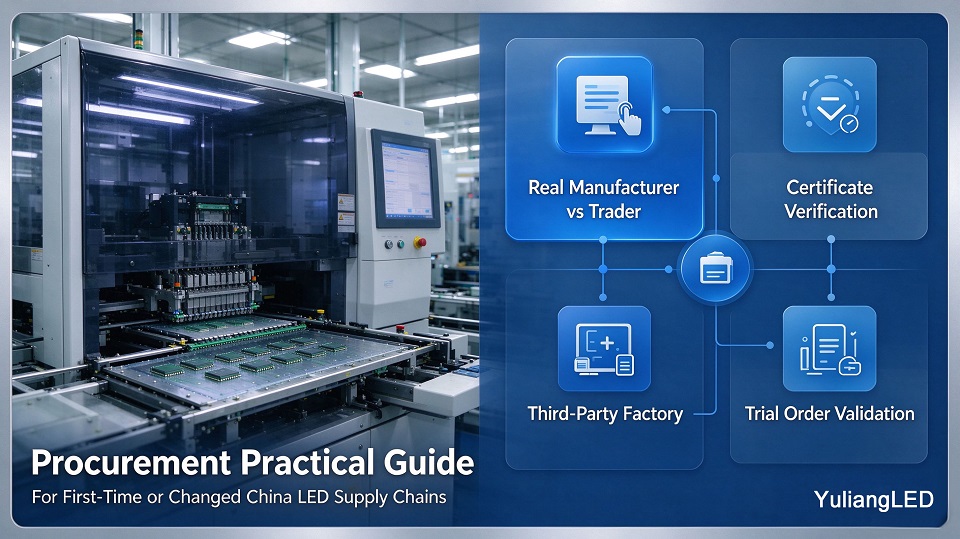
Part 1: Real Manufacturer vs. Trading Company — How to Tell the Difference
A genuine integrated manufacturer controls product design, production and quality in-house. A trading company sources products from external factories and resells them with a markup. Neither is inherently wrong — traders can be useful for small mixed orders — but a trader posing as a factory creates hidden risk: you have no visibility into actual production, no direct technical support and no leverage when quality or delivery issues arise.
Use this layered verification framework to identify what kind of supplier you are actually dealing with.
Step 1: Desk research — verify the legal entity
Start with official documents before you even speak to a salesperson.
-
Check the business license scope: Request the official business license and examine the registered business scope. A real manufacturer will include explicit manufacturing terms such as "production", "manufacturing" or "processing" in its scope. A pure trading company will only list sales, wholesale and import-export terms. You can cross-check Chinese company registrations through the national public enterprise information database.
-
Match the certificate name to the company name: The legal entity name on certificates must match the name on your purchase contract. If the ISO certificate is issued to "Factory A" but your contract is with "Trading Company B", the certification does not apply to your supplier — they are simply borrowing someone else's credentials.
-
Verify the physical address: Cross-check the factory address on satellite maps. Real LED factories are located in industrial zones on city outskirts, with large factory buildings, loading docks and logistics access. A supplier whose address resolves to a high-rise commercial office building in a central business district is almost certainly a trading company, regardless of what their website claims.
Step 2: Technical questioning — test their production knowledge
Ask specific production-related questions during your first call. Real factory staff can answer immediately; traders will hesitate, deflect or need to "ask the engineer".
Effective screening questions:
PREVIOUS ARTICLE