









How LED Supply Chain Stability Impacts Enterprise Procurement
October 26, 2026
For procurement teams and engineering managers sourcing LEDs at scale, supply chain resilience is no longer a secondary consideration — it is a core determinant of production continuity, cost control and product quality. As recent led supply chain news has shown, volatility in upstream chip production, packaging material availability and global logistics can ripple through the entire value chain, creating shortages, delivery delays and unexpected batch-to-batch variation for unprepared buyers.
Understanding how the led supply chain works, where risks accumulate, and how to systematically evaluate suppliers through structured audits is the most effective way to protect your production schedule, your product quality and your budget. This guide breaks down the full LED supply chain from chip to logistics, explains its impact on enterprise procurement, and outlines a supplier audit framework to reduce sourcing risk.
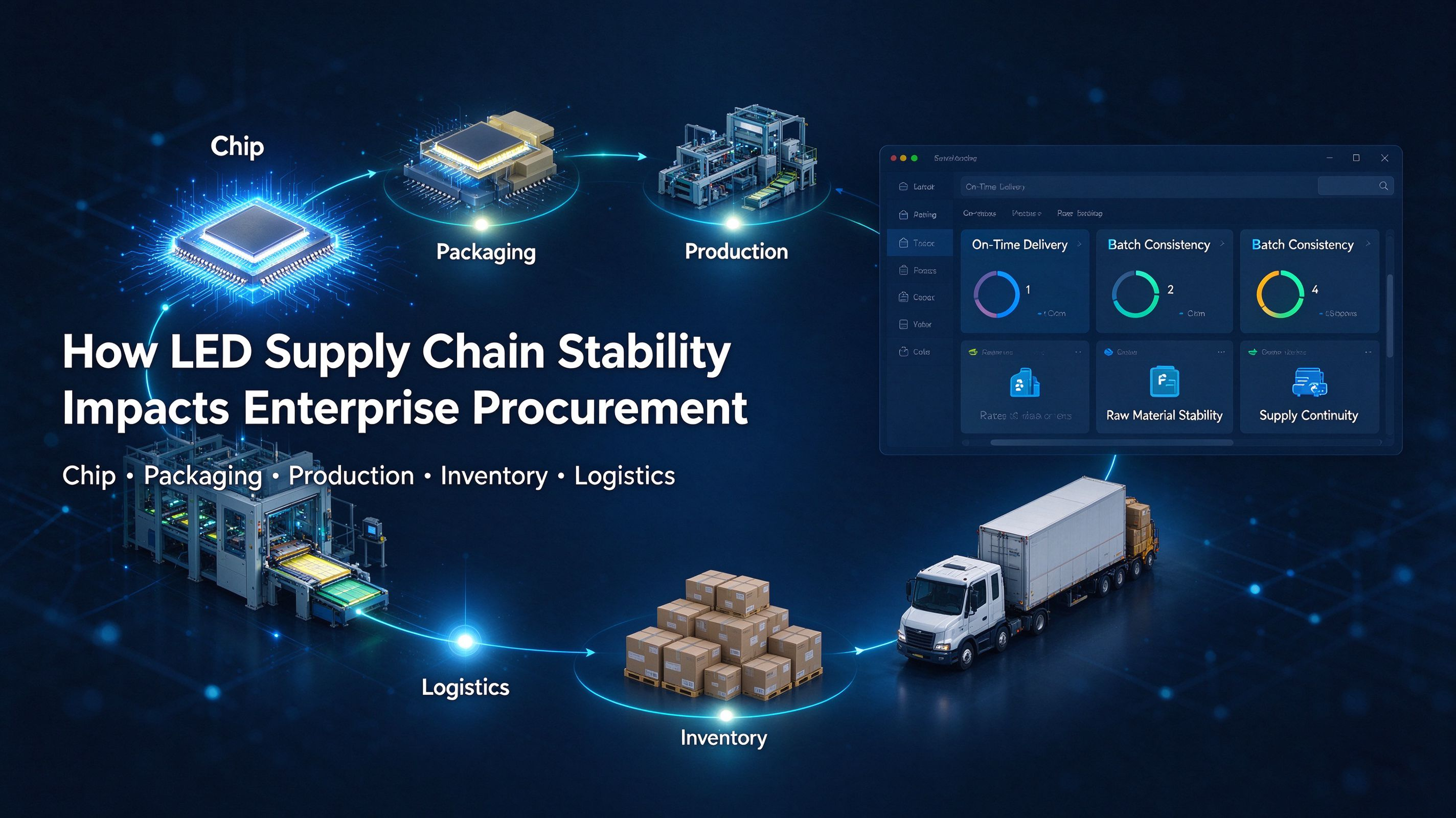
Breaking Down the LED Supply Chain: Where Risks Originate
The LED supply chain is a multi-stage ecosystem, and disruption at any single stage can delay or degrade your final delivery. Effective procurement risk management starts with understanding each link and its typical failure points.
1. Chip manufacturing: The upstream bottleneck
LED chips begin as epitaxial wafers grown on sapphire or silicon carbide substrates, then processed, diced and tested. This is the most capital-intensive and capacity-constrained stage of the entire chain.
-
Capacity allocation risk.
-
Price volatility.
-
Quality variation at source.
2. Packaging: The bridge between chip and finished LED
Packaging attaches the LED die to a substrate, connects bond wires, applies encapsulant and forms the final SMD package such as 3528, 5050, 3535 or 3014.
-
Material dependency.
-
Process sensitivity.
-
Capacity flexibility.
3. Production & testing: Where consistency is determined
Volume production involves scheduled manufacturing runs, in-process inspection, photometric testing and bin sorting. This is where batch-to-batch consistency is either enforced or lost.
PREVIOUS ARTICLE